
Product
One integrated platform. Not a plug-in.
ProClinic captures the consultation, retrieves the patient history, generates the paperwork, and prepares the claim — coordinated by an orchestrated system of specialised clinical agents, grounded in a verified clinical knowledge base, and gated by human approval at every step.
Walkthrough
The full consultation, in under two minutes.
The end-to-end flow
A consultation, end to end.
Every step below is a real screen from the ProClinic beta. Patient identifiers are redacted; every clinical, coding, and safety detail is unretouched.
Sign in
Role-based access with clinician, front-desk, and practice-owner views. Every action from here is tied to an identity and a signed audit trail.
Patient onboarding
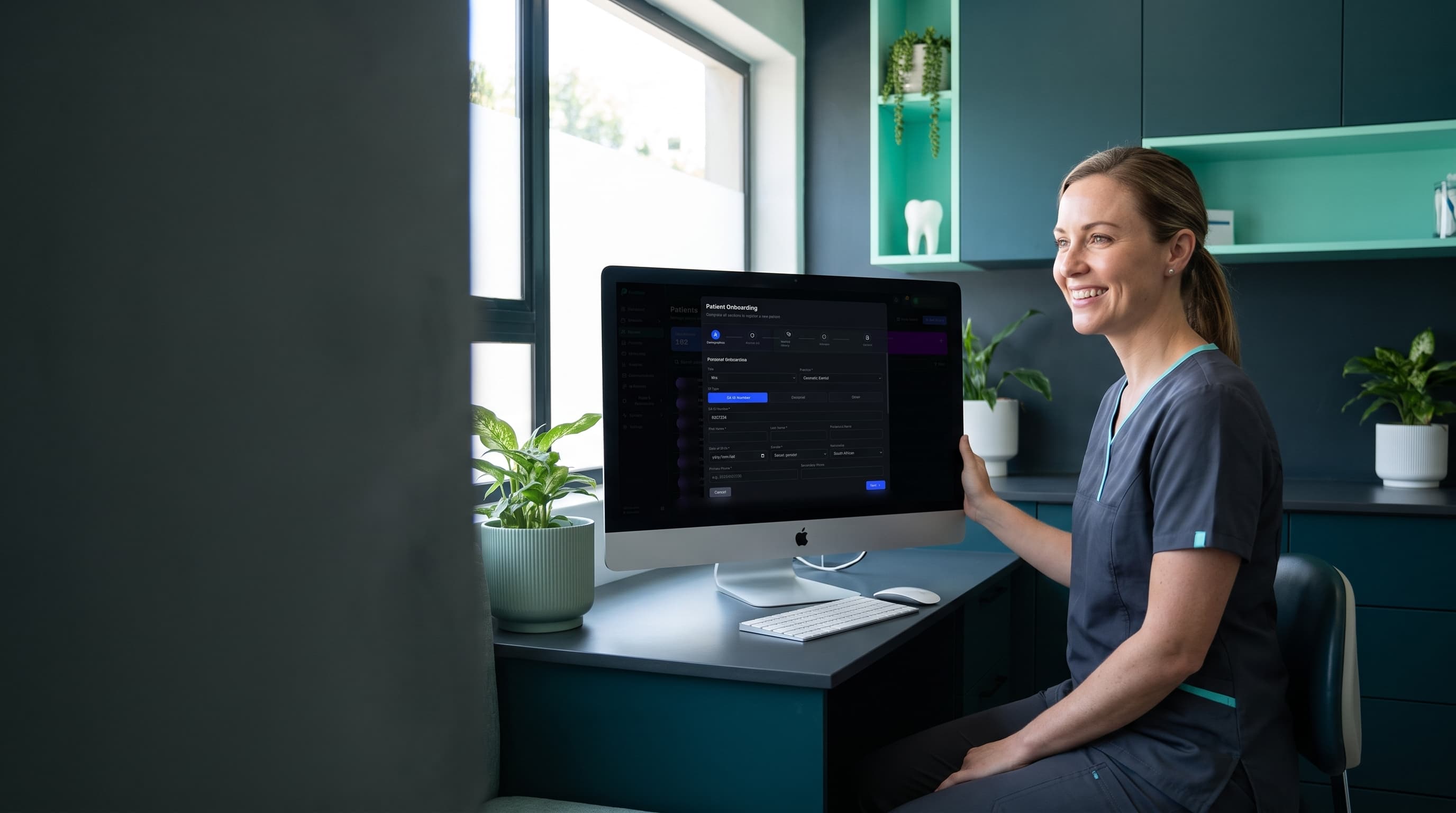
Structured patient onboarding — demographics, contact, medical history, allergies, and medical-aid details — captured once and reused everywhere downstream. Nothing to retype into a script pad, referral letter, or claim.
Schedule
Practice view shows the day at a glance. Book, move, or reschedule an appointment in one gesture — colour-coded by visit type and chair.
Ambient capture
One tap starts room transcription. ProClinic listens to and transcribes the entire visit while the dentist stays hands-on — nothing missed, nothing to type.
Focused clinical input
A short, focused voice recording from the clinician sits alongside the ambient transcript — the clinician’s own words on what matters, in seconds, without opening a keyboard.
AI analysis of transcripts
Specialised clinical agents iterate over the ambient and focused transcripts — retrieving patient history, cross-referencing allergies and interactions, and grounding every clinical claim in the verified knowledge base. Reasoning, tool calls, and iteration count stay transparent — not a black box.
Generated clinical note
A full structured clinical note is drafted from the consultation, waiting for the clinician’s signature. Every clinical claim is grounded in the verified knowledge base — defensible, auditable, and the medico-legal record of the visit.
Additional notes
From the same generated visit, ProClinic drafts everything downstream in one panel — treatment plan, referral letter, prescription with allergy and interaction checks, tooth-chart update, social history, and (from Q4 2026) the dental lab order form. Nothing retyped, everything gated on the clinician’s approval.
Invoice generation
Invoice assembled from the approved treatment plan, with SADA procedure codes and ICD-10 diagnoses attached. From Q4 2026, the same package is designed to hand off to medical-aid switching partners as a submitted claim in a single click.
Architecture
Capture. Reason. Release. One orchestrated system.
A single large model doing everything is a demo, not a workflow. ProClinic runs an orchestrated system of small, purpose-built clinical agents — each with a defined role, a defined tool set, and a defined output contract — sequenced by a central orchestrator with structured JSON and tool-calling.
Central
Orchestrator
Capture
Agents that listen, transcribe, and structure
Ambient transcription, focused clinician dictation, and diagnostic file intake — every word of the visit brought in and structured, without a keyboard.
Reason
Agents that draft against the verified knowledge base
Note generation, history retrieval, allergy and interaction checks, treatment planning, coding, prescriptions, referral letters, invoices, and claims — each output grounded in clinician-verified content, never invented from memory.
Release
Agents that only ship after human approval
Approval gates, audit-trail writers, and downstream release to the patient, medical aid, laboratory, and ledger — nothing leaves ProClinic until a clinician has signed the corresponding gate.
The number of agents grows as the platform grows. What stays constant is the pattern: each agent is single-purpose, grounded in the verified knowledge base, and gated by human approval before anything downstream fires.
Verified knowledge base
Grounded, not guessed.
A clinical assistant you can sign your name to has to do one thing that a general-purpose model cannot be trusted to do on its own: keep every clinical claim tethered to something real. Every clinical output ProClinic drafts — note, plan, prescription, referral, code, or claim — is anchored to a knowledge base that clinicians have reviewed and signed off on.
Principle 1
Clinician-verified content
ProClinic draws from a curated body of clinical content maintained under clinical governance — not from whatever the model happened to memorise during training. Every entry is reviewed and signed off by a clinician before it can be used to generate an output.
Principle 2
Grounded generation
When ProClinic drafts a note, plan, prescription, or claim, the reasoning is anchored to the verified content, not improvised. The AI is a fast, tireless colleague — but never the final source of truth. The dentist keeps the final say at every step.
Principle 3
Insufficient-evidence handling
If the grounding is there, the output is generated. If it isn't, ProClinic says so and hands the decision back to the clinician, rather than filling in the blank. The same discipline a careful clinician already applies at the chair: cite what you know, say when you don't, and never sign what you can't defend.
Medico-legally
Every clinical claim in a generated record is defensible. If a note is challenged months later, the audit trail shows exactly what grounded the generation, and when.
Operationally
Coding suggestions are justified, not asserted. A rejected medical-aid claim can be investigated in minutes, not weeks — and the same grounding shortens the path back to a corrected resubmission.
Clinically
Prescriptions are checked against the patient's allergies and interactions before the clinician signs. ProClinic doesn't just draft a script; it surfaces the reason to think twice before signing one.
Under the hood
The stack.
Every layer chosen for reliability, auditability, and South-African data residency.
Cloud
Enterprise-grade, hosted on AWS
Patient data lives on enterprise-grade managed cloud infrastructure with automated backups, point-in-time recovery, and multi-region-ready architecture for global scaling.
Data
Enterprise Postgres
Relational core with hybrid retrieval for the verified knowledge base. Encryption at rest and in transit, modern TLS everywhere, point-in-time recovery.
Retrieval
Verified knowledge base
Every clinical claim is grounded in clinician-reviewed content. Cite-or-refuse retrieval — the model surfaces what it can defend, or hands the decision back to the clinician.
Approval
Human gates at every step
No clinical, patient-facing, or financial output ships without a clinician’s signature. Approval is enforced in the workflow — not left to discipline.
Audit
Continuous, signed audit trail
Every agent call, every retrieval, every approval, and every claim is logged, timestamped, and searchable. Full replay of any consultation on demand.
Access
Role-based, MFA, tenant isolation
Role-based access control with multi-factor authentication for clinicians. Practice-scoped data isolation — no cross-tenant leakage by construction.
Integrations
Designed to sit alongside the tools your practice already runs.
From Q4 2026, ProClinic is designed to sync with the leading South African accounting platforms practices already use — so the numbers your bookkeeper needs land in your ledger without a second capture. Medical-aid switching partners plug into the same claim pipeline, so an approved invoice becomes a submitted claim in a single click.
Accounting
Leading SA accounting platforms
Chart of accounts, invoicing, VAT, and reconciliation — designed to sync to the ledger your practice already uses.
Medical-aid switching
SA switching partners
Real-time benefit checks, claim submission, and automated resubmission on denial — designed to close the loop at the chair.
Laboratory workflows
Dental lab notes
Dental lab order forms generated from the visit data — the clinician’s intent captured once, then handed to the bench without a second capture.
What's next
ProClinic Coach — an AI business analyst for your practice.
From Q4 2026, ProClinic Coach is designed to turn the numbers your practice already generates — schedule, production, recall lists, no-shows — into a running read on where chairs are empty and where money is quietly slipping through the cracks. Practice owners get a mobile view that surfaces the questions worth asking each morning. Clinicians see nothing they didn't want to see.
ProClinic Coach is a working title for our AI business-analytics agent. Name subject to change ahead of public release.
Q4 2026
Designed to answer:
- Which chair is running below capacity, and on which days?
- Which recalls haven't been contacted in the last 90 days?
- Which presented plans didn't convert, and where in the funnel they stalled?
- Which denials are recurring, and against which scheme rules?
Roadmap
Where ProClinic is going next.
The launch platform is a full dental practice operating system. Q4 2026 extends it out to medical-aid switching, laboratory workflows, integration with the leading SA accounting platforms, and ProClinic Coach — our AI business-analytics agent. Q1 2027 opens the same platform to medical general practitioners as ProClinic Medical.
Q3 2026 · Live
Launch platform
- Ambient capture and structured clinical documentation
- SADA + ICD-10 coding with verified knowledge base
- Prescription, referral, and lab order agents
- Invoicing and claim packaging
- Human approval gates and full audit trail
Q4 2026
Practice growth
- Medical-aid switching integration via switching partners
- Dental lab notes — lab order forms generated from visit data
- ProClinic Coach — AI business analytics for chair utilisation, no-show forecasting, and treatment-plan conversion
- Multi-practice group rollout tooling
- Sync with leading South African accounting platforms
Q1 2027
ProClinic Medical
- Adaptation of the platform for medical general practitioners
- ICD-10 medical coding depth
- Speciality-aware note templates and referral workflows
- Preserves the same governance model — verified knowledge, human approval, audit trail
Roadmap targets. Delivery dates are indicative and subject to clinician and regulatory validation.
Security & data residency
Patient data, handled with discipline.
Data residency
Patient data lives on enterprise-grade managed cloud infrastructure. Cross-border transfer is disabled by default and only enabled with explicit clinician consent — with multi-region readiness for global scaling.
Encryption everywhere
Modern TLS in transit, AES-256 at rest. Field-level encryption on sensitive PII. Managed keys in AWS KMS with least-privilege access policies.
Access control
Role-based access. Multi-factor authentication for clinicians. Practice-scoped data isolation — no cross-tenant leakage by construction.
POPIA compliance
Registered Information Officer. Documented lawful basis, consent, purpose, and retention rules. Data-subject rights workflows built into the product.
Auditability
Every agent call, every retrieval, every approval, and every claim is logged, timestamped, and signed. Full replay of any consultation on demand.
Clinical governance
Verified knowledge base under clinician review. Every clinical claim is grounded in signed-off content — if the evidence isn't there, the model says so instead of fabricating.
See what ProClinic can do for your practice.
Join the waitlist for product updates and early access, or apply to work with the founding team.